




By David E. Oguzierem
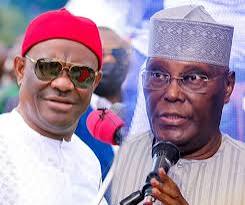
The People’s Democratic Party (PDP), once hailed as the largest political party in Africa, now finds itself a shadow of its former self. What was once a dominant political force is now teetering on the brink of collapse, struggling to remain relevant amid a series of self-inflicted crises. One of the most pressing issues facing the party is the burgeoning alliance between Chief Nyesom Wike, the current Federal Capital Territory (FCT) Minister; Ambassador Illia Damagun, the acting National Chairman of the PDP; and Senator Samuel Anyanwu, the National Secretary. This seemingly unholy coalition is further complicating the internal struggles of a party already on life support.
Many political analysts are taken aback by Wike’s increasingly rebellious stance, raising serious concerns about the PDP’s future. Once a stalwart of the party, Wike’s recent actions suggest an obsession with power at any cost, including alliances with opposition figures that many see as detrimental to the PDP. Rather than strengthening the party, this collaboration appears designed to weaken its influence in key regions, notably Rivers State, where Wike’s political ambitions are at odds with those of Governor Siminalayi Fubara, his former protégé.
The political tension in Rivers State is palpable. Governor Fubara, still trying to assert his authority as the newly elected leader, is finding himself caught in Wike’s web of intrigue. Instead of offering support, Wike seems intent on undermining Fubara’s leadership, creating a political deadlock that serves Wike’s broader ambitions but threatens the long-term viability of the PDP in the state.
A notable development in this unfolding drama is the decision of South-South governors to boycott the Nigeria Governors’ Forum (NGF) meetings, including the National Economic Council (NEC). This unprecedented move highlights their growing frustration with the NGF’s inability to protect its members—particularly Fubara—from Wike’s relentless political maneuvering. The boycott underscores a deepening rift and raises broader questions about Wike’s influence, not just within the PDP but across Nigeria’s political landscape.
Wike has been accused of using his federal position to destabilize Rivers State while sowing discord within the PDP. His inflammatory statements, particularly those targeting Governor Fubara and other PDP governors, have drawn sharp criticism from within his party. Many are now calling on President Bola Tinubu to intervene and rein in his controversial appointee.
The Decline of the PDP in Rivers State
The consequences of Wike’s actions are reverberating through the PDP. Reports from within the party suggest a growing fracture, with many constituents losing faith in its leadership. This disillusionment has manifested itself in recent local elections, where the PDP’s absence was glaring. The relatively new APP party claimed victory in 22 local government areas, with AA winning one, leaving the PDP in a precarious position. This decline in grassroots support marks a significant blow to the party’s influence in Rivers State, which was once a stronghold.
Wike’s ambitions have also rippled through the ranks of the opposition. As soon as he assumed office as FCT Minister, he moved to disband the elected executive of the Rivers APC, controversially installing his cousin, Tony Okocha, as caretaker chairman. This bold move has created further political turbulence, complicating the already fragile dynamics in the state.
A Fractured PDP Governors’ Forum
The response from other PDP governors has been mixed. While Wike enjoys the support of key figures like Ahmadu Fintiri of Adamawa and Seyi Makinde of Oyo, the silence from many first-term governors has been conspicuous. This silence speaks volumes about the uncertainty and division permeating the party. Enugu State Governor Peter Mbah, in particular, has taken a much quieter approach compared to the vocal backing his predecessor offered. This shift raises questions about where the loyalties of first-term governors lie and whether they are willing to take a stand against Wike’s disruptive actions.
Amid the chaos, Governor Bala Mohammed of Bauchi State has signaled his own presidential ambitions, drawing further attention to the widening cracks within the party. Damagun’s recent outreach to Mohammed, invoking regional solidarity, suggests an attempt to rally the party together. However, the deeply entrenched divisions within the PDP make such efforts seem more aspirational than practical.
The Atiku Factor
Further complicating the picture is former Vice President Atiku Abubakar’s ambition for the 2027 presidency. Atiku’s aspirations have unsettled several PDP governors, including Fintiri, Mohammed, and Makinde, all of whom are believed to harbor presidential ambitions of their own. The shifting allegiances surrounding Atiku are adding fuel to an already volatile situation.
The PDP has survived internal crises in the past, but the current situation represents one of the most significant threats to its unity since its formation in 1998. If the party fails to address these internal divisions, it risks becoming irrelevant in Nigeria’s political landscape.
Wike and the G5
Wike’s leadership of the G5 faction, which continues to assert influence even as he serves in an APC-led administration, underscores the complexity of the current PDP crisis. His insistence on maintaining control within the PDP, while serving in a federal government run by an opposing party, highlights the contradictory and fraught nature of his political maneuvers. This dual allegiance has only deepened mistrust within the PDP, leading many to question his true intentions.
Despite the mounting challenges, PDP spokesperson Kola Ologbondiyan remains optimistic, insisting that the party can survive this turbulent period. However, much depends on Damagun’s ability to withstand pressure from factions seeking to undermine the party’s integrity.
The pro-Damagun faction has been vocal in its support for the current National Working Committee (NWC), arguing for Damagun’s return to his previous role as Deputy National Chairman. Yet, this internal power struggle threatens to weaken the party further, particularly as crucial elections loom on the horizon.
Calls for sanctions against Wike and his allies have grown louder, with some party members advocating for expulsion. However, given the deep divisions within the PDP, the feasibility of such actions remains unclear.
Governors across the South-South have expressed their outrage over Wike’s actions, demanding immediate intervention from President Tinubu. They argue that his behavior is not only destabilizing Rivers State but also jeopardizing the economic and political stability of the region.
In the coming weeks, the PDP must confront its internal divisions with urgency. The stakes are higher than ever, and the party’s survival may depend on its ability to reconcile its differences and chart a unified path forward.
The question remains: will the PDP emerge from this crisis stronger, or will it fracture beyond repair? As the political storm rages on, only time will reveal the fate of a party once considered the behemoth of Nigerian politics.
David Oguzierem is the chairman of Rivers Defense Alliance(RIVAL)






Add Comment